Friday, April 22, 2011

Mary Connealy on Writing Action Scenes

Today, I’m writing about grinding action to a halt.

An action scene is hard to write, at least for me. I picked a scene from The Husband Tree, which is re-releasing in May in a book called Montana Marriages Trilogy that contains three of my already published books. There is a scene where wolves attack, very tense action scene.

I'm going to use that as an example.

Here’s what I’ve learned about action scenes.

When I first write them they are always wrong. Did you hear that? Always. Always. Always.
I cannot do it right the first time. Admitting that helps me, because a really good action scene always stops me when I’m writing. I start backing up. I revise the chapter before. I maybe go reread my copy of War and Peace, anything to avoid writing the action scene, because I can’t picture it. I can’t get the words right to kick it off. 

Admitting I have a problem is the first step.
Um. . .I didn’t say that first.

I’ve just got to forge ahead and do it WRONG. Then I begin to revise. It’s not uncommon for me to rewrite an action scene ten times. Some of it major rewriting, some minor tweaking. I’ve learned that they always get better on revision. If I rewrite it an eleventh time, it will get better again. You can just keep tweaking, upping the stakes, speeding up the pace, picking stronger words, forever. Eventually I have to call it good, but I definitely don’t call it good at first.

So here’s what I look for.
Short sentences.
No asides.
No interior musing.
NO NO NO NO backstory.
Action, focus, wolves, prowling, tension.

Go look at a scene with a lot of action--I'll add here that comedic action counts, so it’s not just scary action.
Is there backstory in it? This is NOT the time.
Do we pause in the middle of the woman falling out of the tree into the pack of snarling, ravenous wolves for her to ‘regret that she’d never see her children again.’ Okay, you can do that. But SHORT. No lingering. She’s falling. Don’t forget it for a SECOND.
A lot of that you just can’t see on the first pass. So plow forward to get it written, then go back later and fix it.
Here’s an excerpt from the Wolf Attack scene.

~~~~~~~~~~~
      The wolves were closer now, and a chill that had nothing to do with the weather raced up Belle's spine.
      They’d found something for their supper—her.
      With two babies to care for, she ran faster. She saw a lighter area ahead and knew she needed to make that so she could have a field of fire. In the woods, the wolves could be on her before she knew they were coming. She needed to find a tree to climb or a rock wall to cover her back with a good open area in front of her.
      Suddenly the baying of the wolves stopped. She felt the evil in the silence. She knew they were coming.
      Now.
      Quiet.
      Stalking her.
      The heavy shroud of trees thinned and she saw the sky for the first time in a while. There was enough light for her to see a Ponderosa pine with branches low enough to grab ahold. The back of her neck prickled as she waited for the first wolf to pounce.
      She sprinted for the tree. She heard the nearly soundless rush of something behind her and she whirled and stared into wicked yellow eyes and bared fangs already airborne. Her hand was on her pistol. She fired without making a conscious decision to shoot.
      The noise and the smashing bullet knocked the wolf back. Two wolves behind this one whirled back into the cover of the trees, breaking off the attack. Belle saw eyes glowing in the moonlight. Staring at her. Hungry.
      She backed to the tree. Glancing behind her, she holstered her gun and caught the first branch. She swung up. The wolves came at her with a rush. She clung to the branch with her arms and legs. She had surprising speed for a woman with a baby on her chest.
      One of the wolves caught her dangling buffalo robe in his teeth. The weight of the wolf almost knocked her to the ground. Belle knew it was hang on or die and she had the grit to hang on.
~~~~~~~~~~~
I'll make a comment about the TWO BABIES...Belle has just realized she's pregnant. So she's got her one year old strapped on her chest and the second baby she refers to is the one she's carrying inside. (this is a test, a quiet test. I'm giving away a book today, but you'll only know about it if you were brave enough...stubborn enough...gullible enough...to read this post all the way to the end-then leave a comment that includes your favorite animal for tearing women limb from limb--in fiction--or whatever)
Okay, I'm back. Any comments? Any dead spots? I see a few.

This sentence: The heavy shroud of trees thinned and she saw the sky for the first time in a while.
I'd rewrite it, my first instinct is to simply drop... 'in a while.' But if it drop it, I might end up rewriting the whole sentence before I'm done, because it's not like it's the first time she's seen the sky, for heaven's sake.
I like the word 'shroud' sounds like a death shroud.

This sentence:
Two wolves behind this one whirled back into the cover of the trees, breaking off the attack.
To me, this is a little slow. Whirling takes a couple of seconds. Why didn't Belle shoot them in those seconds. I should have said: Two more wolves vanished into the cover of the trees, breaking off the attack.
Or wait, maybe: The rest of the pack vanished like ghostly smoke. Belle fired twice more into the underbrush then stopped, afraid to empty her gun.
sigh

I want to rewrite both of those sentence again. You can see that what I end up with barely resembles what I've started with. But I need to get the....framework let's say...of the scene written before I can make it MOVE.
You see the tweaking?
I just can't stress enough this

THE BEST WRITING IS REWRITING
Carve that into your monitor. Well, maybe just write it on a sticky note. Monitors don't really respond well to carving.

Any changes I want to make...too late now. But I can live with that because, like I said, it could always be better.
And, okay, I've never read War and Peace. But I've read Anna Karinina, so I think I've been punished enough.


Mary Connealy writes fun and lively "romantic comedy with cowboys". Deep Trouble, her latest novel released May 2011. She is the author of the successful Lassoed in Texas, Montana Marriages, and Sophie's Daughters series. Her novel Doctor in Petticoats is a finalist for a Rita Awards, her novel Calico Canyon was nominated for a Christy Award and her novel Cowboy Christmas won the Carol Award. She lives on a ranch in eastern Nebraska with her husband, Ivan, and has four grown daughters, two fine sons-in-law and two spectacular grandchildren.


Thursday, April 21, 2011

Progress: Another Remodeling Project Underway


I need to take another shot without the lights on because you can't see how awesome there are.


The insides of the bookcases are only primed. They will match the walls and have glass doors.
This was a HIDEOUS craggy rock wall with an ugly mantle. It's almost finished!
I'll do a before and after pic.

Monday, April 18, 2011

Review Free Christian Books

Pelican Ventures Book Group is launching a new site where people can help us in pollinating the world with Christian Fiction. At Book Buzzin' readers can apply for a no-obligation, no cost membership to receive free review copies of the latest Christian Fiction. 

What's the catch? There isn't one! All a Book Buzzin' member has to do is agree to Buzz about a book--and only if he/she enjoys it! For more information and to apply for membership, visit http://www.bookbuzzin.com

Friday, April 15, 2011

Amanda Cabot: When Happily-Ever-After Isn’t Enough

 PHILOSOPHICAL FRIDAY

Each Friday between April 1st until the end of June, I will bring you an author's perspective on various and sundry aspects of writing. Remember to check back or subscribe to this blog, using the link in the right-hand sidebar, so you don't miss any great writing tips!

I'll be featuring Amanda Cabbot every other week, so expect more good offerings from her. Everybody's favorite writer of comedy with cowboys, Mary Connealy will make appearances as well. Don't miss these insightful messages from the minds of great writers.


“Nothing happens.”  

 It’s been many years since I received that particular rejection, but I still recall my confusion.  How could the editor say that nothing happened?  I was writing short contemporary romances for the secular market at the time, and I thought I’d done everything right.  The book was set in an exotic location and was laced with fascinating (at least to me) details of life in a place most of us only dream about seeing.  My hero and heroine met, they fell in love, and after resolving a few misunderstandings, they lived happily ever after.  What could be wrong?  And why did the editor say that nothing happened?

When I recovered from the sting of rejection, I realized that the editor was right, although I still thought she was wrong in saying that nothing happened.  What she should have said was that nothing interesting happened.  I had written a story of a close-to-perfect romance, and while readers might want to live that story, they don’t want to read about it.  Perfection is boring, or as Tolstoi said in his famous opening to Anna Karenina, “Happy families are all alike; every unhappy family is unhappy in its own way.”  What was missing from my book was conflict.

I hate conflict.  After one of those stress job interviews that used to be popular, the recruiter looked at me as if I were an unknown species.  “You’d rather walk around a wall than through it,” he said.  Duh!  Who would willingly bang her head against a wall?  There’s only one winner there, and it’s not the head.  But that aversion to pain and conflict wasn’t helping my writing.  If my characters weren’t willing to fight, if I wasn’t willing to put them through pain, then I was going to continue receiving rejection after rejection and hearing editors say, “Nothing happens.”

 I wanted to make another sale, but I hated the idea of torturing my characters, and that’s how conflict felt to me.  It seemed like an insurmountable impasse.  And then I realized what I had to do.  It might seem like a matter of semantics, but the technique worked for me.  I told myself that I wasn’t torturing my characters; I was healing them.  And since I believe in the healing power of love – both God’s love for us and that between a man and a woman – it became easy (okay, a teeny, tiny bit easier) to create characters who were in pain.  Sometimes the pain was emotional.  Sometimes it was physical.  Though I wept and cringed as I wrote some of the scenes, I wouldn’t let myself off the hook.  No matter how dark the story was, I knew that eventually I would give my characters – and my readers – what they deserved: healing, followed by a happily-ever-after.

And now, as I give thanks for the people who’ve touched my life, I include the editor who told me, “Nothing happens.” 


Amanda Cabot has always been a dreamer, and so it’s no coincidence that her first books for the CBA market are called Texas Dreams.  Set in the Hill Country beginning in 1856, these deeply emotional historical romances showcase God’s love as well as that between a man and a woman.  The first in the trilogy, Paper Roses, was a finalist for the Carol Award.  Scattered Petals received critical acclaim, and the final Texas Dreams book, Tomorrow’s Garden, has just been released.  A former director of Information Technology, Amanda has written everything from technical books and articles for IT professionals to mysteries for teenagers and romances for all ages.  She’s delighted to now be a fulltime writer living in Cheyenne, WY with her high school sweetheart/ husband of many years.


As the seed awaits the spring sunshine, so one young woman hopes for a brighter tomorrow. 
Harriet Kirk is certain that becoming the new schoolteacher in Ladreville, Texas is just what she needs—a chance to put the past behind her and give her younger siblings a brighter tomorrow. What she didn’t count on was the presence of handsome former Texas Ranger Lawrence Wood—or the way he affects her fragile heart. But can Harriet and Lawrence ever truly conquer the past in order to find happiness?  Book 3 in the Texas Dreams series, Tomorrow’s Garden is a powerful story of overcoming the odds and grabbing hold of happiness.


Monday, April 11, 2011

The Incredible Shrinking Tuna Can

No, it's not just your imagination that everything in your grocery aisle appears smaller or more expensive than a year or two ago. And food manufacturers are still stealthily slashing ounces from packages, in hopes you won't notice.

http://www.dailyfinance.com/story/market-news/u-s-companies-shrink-packages-as-food-prices-rise/19897911/

Friday, April 08, 2011

Deborah Hale: What to Pack In Your Short Synopsis


PHILOSOPHICAL FRIDAY


Synopsis writing is like packing a suitcase. Your story is a large wardrobe, and when you write a synopsis, you 'pack' only items you're likely to need. A one-page synopsis is like a carry-on bag. Taking every item of clothing from the larger suitcase and cutting off sleeves or a few inches from the hem to make them all fit really isn't the way to go!

You need to start from scratch, deciding what you’ll need for wherever you're going. You don't want to run out of underwear, and you don't have room to pack your favorite sweater if you won’t wear it. 

If some items will do double duty by mixing and matching, you'll save room for other clothes. That's what you need to do with a short synopsis -- include what you need, leave out what isn't essential and try to make some items do double duty.  Here are the essentials to pack into your short synopsis.

Hook Sentence: Pique interest, show story hooks (secret baby, bodyguard, Cinderella, etc.) Pose story question: “Can a Greek ugly duckling find happiness with her WASP prince charming in spite of her colorful, interfering family?”

Heroine Goal/Motivation: Who is the heroine, what does she want and why does she want it?

Hero Goal/Motivation: Who is the hero, what does he want and why does he want it?

Situation: How are the hero and heroine thrown together, and why is this going to cause trouble for them? It may be obvious if their goals are opposed. If they are opposites in some way that will make
the situation volatile, spell it out here.

Budding Attraction: When and how do they begin to fall for one another?

Non-Physical Attributes that Attract: Why do they fall for one another? What is it, besides looks, that appeals? Loyalty, strength, humor, intelligence?  Make it something that the editor would expect based on what you’ve told her about the characters. If the heroine is on the run from an abusive situation, a combination of protective strength and gentleness in the hero would appeal to her.

Complicating Events: Events in the plot that push the characters toward each other or away from each other. Usually early events push them together, which they resist because of internal conflict issues. Later events may have the potential to destroy their blossoming love.

Emotional Complication/Internal Conflict: Why is each event emotionally significant to these characters? How and why does it push them together or apart? I cannot stress enough how vital this is. If a plot event provides no emotional complication, leave it out of your short synopsis.

Black Moment: The most destructive complicating event. Makes it seem impossible for these two characters to be together afterward.

Life Lesson/Character Growth: What have the characters learned during the course of the story that allows them to get past the Black Moment and reconnect? How has their interaction with each other changed them in critical ways to help them meet the challenge of the Black Moment?

Happy Ending: Wrap it up in a way that provides emotional resonance for the reader. If the hero’s children figure in the story, they may be part of the wedding party. A significant location may be where the couple wed or honeymoon. The couple’s first child might be named after a significant secondary character.

~ Deborah Hale’s new Gentlemen of Fortune miniseries is on sale now!  Her first Regency romance for Love Inspired Historical will be released in the June anthology, The Wedding Season.

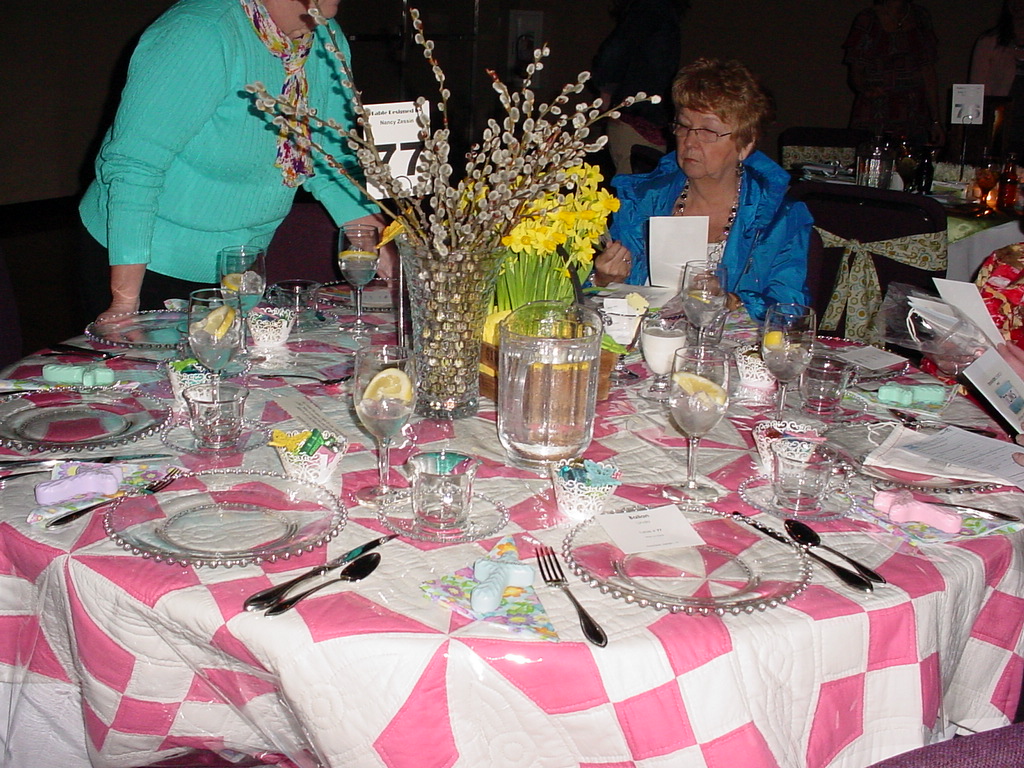
MORE GORGEOUS TABLE SETTINGS FROM THE SPRING DINNER


Wednesday, April 06, 2011

RWA's RITA Finalists in the Novella Category

You still have plenty of time to read the finalists and see what you think!

2011 RITA Finalists for Romance Novella


  • "Blame It on the Blizzard" by Jennifer Greene in Baby, It's Cold Outside  (Harlequin; Marsha Zinberg, editor)
  •  
  • "A Dundee Christmas" by Brenda Novak in That Christmas Feeling (Harlequin Superromance; Paula Eykelhof, editor)
  •  
  • "Friendly Fire" by Jill Shalvis in Born on the 4th of July (Harlequin Blaze; Brenda Chin, editor)
  •  
  • "Love Me to Death" by Maggie Shayne in Heart of Darkness (HQN Books; Leslie Wainger, editor)
  •  
  • "Mistletoe Magic" by Sandra Hyatt in Under the Millionaire's Mistletoe (Silhouette Desire; Krista Stroever, editor)
  •  
  • "Mountain Rose" by Cheryl St. John in To Be a Mother (Steeple Hill Love Inspired Historical; Patience Smith, editor)
  •  
  • "Shifting Sea" by Virginia Kantra in Burning Up (Berkley Sensation; Cindy Hwang, editor)

  • The Wrong Brother" by Maureen Child in Under the Millionaire's Mistletoe (Silhouette Desire; Krista Stroever, editor)

Spring Dinner

My friend Robyn invited me to an annual women's event, which was last night. Ladies sign up to host a table and do their own table settings, decor and favors, then sell tickets to their table. The program was Tammy Trent, who shared her testimony (you can watch it on her website at tammytrent.com) and sang. She was fabulous. I bought both of the CDs she had there, and she signed them for me.

There were 83 tables! Robyn had told me we needed to go early if we wanted to see them, all, so we went an hour early and made it to each one. Ours was right in front of the stage - perfect seats! Here are some of my favorites. Enjoy!


Sunday, April 03, 2011

Help Yourself to a Cup of Coffee

A group of alumni, all highly established in their respective careers, got together for a visit with their old university professor.

The conversation soon turned to complaints about the endless stress of work and life in general.

Offering his guests coffee, the professor went into the kitchen and returned with a large pot of coffee and an eclectic assortment of cups: porcelain, plastic, glass, crystal - some plain, some expensive, some quite exquisite.

Quietly he told them to help themselves to some fresh coffee.

When each of his former students had a cup of coffee in hand, the old professor quietly cleared his throat and began to patiently address the small gathering.

"You may have noticed that all of the nicer looking cups were
taken up first, leaving behind the plainer and cheaper ones. While it is only natural for you to want only the best for yourselves, this is actually the source of much of your stress-related problems."

He continued: "Be assured that the cup itself adds no quality to
the coffee. In fact, the cup merely disguises or dresses up what we drink. What each of you really wanted was coffee, not a cup, but you instinctively went for the best cups. Then you began eyeing each other's cups.

"Now consider this: Life is coffee. Jobs, money, and position in
society are merely cups. They are just tools to shape and contain life, and the type of cup we have does not truly define nor change the quality of the life we live.

Often, by concentrating only on the cup, we fail to enjoy the coffee that God has provided us. God brews the coffee, but He does not supply the cups. Enjoy your coffee!"


The happiest people don't have the best of everything; they just make the best of everything they have...

Friday, April 01, 2011

Amanda Cabot on Writing Books in a Series

PHILOSOPHICAL FRIDAY

Each Friday between April 1st until the end of June, I will bring you an author's perspective on various and sundry aspects of writing. Remember to check back or subscribe to this blog, using the link in the right-hand sidebar, so you don't miss any great writing tips!

I'll be featuring Amanda Cabot every other week, so expect more good offerings from her. Everybody's favorite writer of comedy with cowboys, Mary Connealy will make appearances as well. Don't miss these insightful messages from the minds of great writers.

So without further ado, here's Amanda:


First there were sequels.  Then came trilogies.  Now quartets and even quintets are popping up.  It seems that everywhere you look, authors are creating series of books, and more and more publishers are asking for them.  If you’re thinking about joining the bandwagon, read on.  There are a few things to consider before you get started.

Type of Series
Did you know there’s more than one kind of series?  While others may disagree with the terminology, I divide them into two categories: continuing characters and connected characters.  What’s the difference?  In a continuing character series, the protagonists remain the same, while secondary characters and sometimes settings change.  Think of Nancy Drew, Miss Marple and, more recently, Harry Potter.  In each case, you know who the main character is, and part of the pleasure of reading one of these books is knowing that when you finish it, there will be another adventure coming, featuring your favorite people.  Plot-driven books like mysteries, thrillers and suspense make ideal continuing character series.

Connected character series are different.  In them, when the first book ends, those protagonists’ stories are complete, but seeds have been sown for at least one secondary character to star in a subsequent book.  It’s common, but not mandatory, for the protagonists of one book to make cameo appearances in the next one.  Although settings may vary from one book to the next, it is also possible that the setting itself becomes a character.  That’s what happened with my Texas Dreams series.  The stories form a connected character series, with the hero of Scattered Petals being introduced in Paper Roses, and Tomorrow’s Garden’s hero making his debut in Scattered Petals, but in addition to those connections, the town of Ladreville and a cast of secondary characters form a common thread.  Character-driven books like romances and general fiction are good candidates for connected character series.

Number of Books
Once you’ve decided which type of series is right for you, the next question is to decide how many books will comprise that series.  In the case of continuing characters, the answer is frequently “I don’t know.”  That’s because those series are often open-ended.  Connected character series, however, are typically finite.  Since trilogies seem to be particularly popular now, my recommendation is to think in terms of three books.  And, if you’re writing a continuing character series, I’d suggest including at least three books in your initial proposal so that there’s no question that it’s a series. 

The Challenges
Although there are many challenges associated with writing a series, for me, three stand out.

1.  Maintain consistency from book to book.  Readers are intelligent.  They’ll remember that Susie had green eyes in Book One, and if those suddenly change to brown in Book Two, unless you mention that she’s wearing colored contacts, your reader will be disappointed in you.  I keep a chart with all characters’ ages, hair and eye colors and other dominant characteristics.  Unfortunately, I did not include characters’ horses’ names on that chart and, halfway through Tomorrow’s Garden, found myself paging through Scattered Petals to see what I had called Lawrence’s horse.  Note to self: include horses on chart.

If you’re using the same location from book to book, I highly recommend having a map that shows where houses, rivers and other landmarks are located.  Once again, readers will notice if you change the street names between books.  Even if you’re using a real town, it’s important to know where the characters live so that you’re consistent. 

2. Create each book as a stand-alone.  I know, I know.  We’re talking about books in a series, so why am I suggesting that each one be a stand-alone?  For me, there’s nothing more frustrating than picking up the second book in a series and feeling as if I’m a stranger at a party where everyone else knows each other.  They’re all talking about people and events that are unfamiliar to me.  If you write each book with the idea that it can stand alone, you’ll make readers happy.  The key is to ensure that each reference to a prior book has a brief explanation, bringing the reader “up to speed.”  The challenge, of course, is to not give away key plot points from previous books.  Is it easy?  Of course not.  That’s why it’s a challenge.

3.  Make each book as compelling as the previous one.  For me, this is the most difficult challenge of all.  I’ve read so many trilogies, including some written by New York Times bestselling authors, where the first and third books were excellent, but the middle one fell short that I started asking why.  Was this an extreme case of the sagging middles that we’re all told to avoid?  Was it like sophomore slump?  I suspect part of the problem is that, as authors, we’re excited about the first book, but when we get to the second, we’re anxious to finish the series, and the second book suffers.  Don’t let that happen. 

I wish I could give you concrete advice on how to avoid the middle book doldrums.  All I can say is to be aware that this is a potential problem and one that afflicts even bestselling authors.  If you have critique partners, ask them whether this book is as good as the previous one, and if the answer isn’t the one you wanted, ask yourself what you can do to improve it.  Your readers expect excellence.  Don’t disappoint them.

For me, although there are undeniable challenges involved, writing books in a series is great fun.  I love the challenge of creating a town and peopling it with interesting characters, then returning to it a second and third time.  I love introducing characters in one book, then following them into a second book.  I love every aspect of it except one: saying good-bye.

Writing books in a series can be a fulfilling experience.  If you’re at all intrigued by the idea, I encourage you to try it.

Amanda Cabot has always been a dreamer, and so it’s no coincidence that her first books for the CBA market are called Texas Dreams.  Set in the Hill Country beginning in 1856, these deeply emotional historical romances showcase God’s love as well as that between a man and a woman.  The first in the trilogy, Paper Roses, was a finalist for the Carol Award.  Scattered Petals received critical acclaim, and the final Texas Dreams book, Tomorrow’s Garden, has just been released.  A former director of Information Technology, Amanda has written everything from technical books and articles for IT professionals to mysteries for teenagers and romances for all ages.  She’s delighted to now be a fultime writer living in Cheyenne, WY with her high school sweetheart/ husband of many years.


Wednesday, March 30, 2011

Reasons Why The English Language Is Difficult To Learn

1. The bandage was wound around the wound.
2. The farm was used to produce produce.
3. The dump was so full that it had to refuse more refuse.
4. We must polish the Polish furniture.
5. He could lead if he would get the lead out.
6. The soldier decided to desert his dessert in the desert.
7. Since there is no time like the present, he thought it was time to present the present.
8. A bass was painted on the head of the bass drum.
9. When shot at, the dove dove into the bushes.
10. I did not object to the object.
11. The insurance was invalid for the invalid.
12. There was a row among the oarsmen about how to row.
13. They were too close to the door to close it.
14. The buck does funny things when the does are present.
15. A seamstress and a sewer fell down into a sewer line.
16. To help with planting, the farmer taught his sow to sow.
17. The wind was too strong to wind the sail.
18. After a number of injections my jaw got number.
19. Upon seeing the tear in the painting I shed a tear.
20. I had to subject the subject to a series of tests.
21. How can I intimate this to my most intimate friend?

And don't forget:
22. That depends on what the meaning of the word is is.

Monday, March 28, 2011

Monday: Cheryl's Writing Advice

Some writers just don't recognize this one crucial aspect regarding why they aren't improving, growing or selling: If you keep writing new material and are mature enough to recognize that you didn't know it all three/ five/ ten years ago, your writing actually improves.

A writer has to grow into their voice.
It's developed. It takes work, effort, time and a lot of crappy throw-away pages. A writer can't actually edit their "voice" in to the pages. I didn't know I even had a voice until my first wonderful God-bless-her editor said I had a Hemmingway style. I wrote it down and then had to figure out what she meant. Put simply (ha): I don't write flowery or beat around the bush. It's kind of like me in person. If there's a simple way to say it or do it, that's what I do.

Trust your instincts on what feels right for you and in developing a story the way you want to see it play out. Underneath the plot are the relationship and the emotions, and that's what you must convey to get readers to connect. Feel the emotion to convey it. Take sufficient time with your story people and their emotional journey.

Monday, March 21, 2011

Today's Guest: Eileen Hinkle Rife


CHOSEN ONES
Eileen Hinkle Rife
Book Three in the Born for India trilogy
OakTara Publishing
March, 2011

"Healing words for hurting hearts," is how Eileen Rife describes her books. Whether through fiction or nonfiction, Eileen wants readers to come away with love that extends beyond themselves, faith that can see the impossible, and hope that endures against all odds.

As a child, Eileen loved writing and telling stories. Walking to school every morning, she created characters, then talked to them as she ambled down the road, which was often her way of dealing with grief and loss. After the death of her brother, Eileen learned to empathize with the underdog. Many of Eileen's stories revolve around issues that many find difficult to talk about—death, homosexuality, sex trafficking. Through her characters, she offers readers an opportunity to draw close, peel back the layers of their own hearts, and examine what lies within.

And added to the mix—romance, always a romance around one corner or another!

An alumna of Christian Writers Guild and member of American Christian Fiction Writers, Eileen has published several non-fiction books, written newsletters, a marriage column, and over ten church dramas. Her byline has appeared in magazines, such as Discipleship Journal, Marriage Partnership, Mature Living, Christian Home & School, Drama Ministry, and ParentLife, as well as other print and online publications. Her fiction works include Journey to Judah, Restored Hearts, and Chosen Ones in the Born for India trilogy released by OakTara.  She and husband, Chuck, a licensed professional counselor and marriage/family therapist conduct marriage seminars for churches and organizations in the States as well as overseas. They have three married children and six grandchildren, all serving the Lord in mission work.   

Visit Eileen: 

 A couple in crisis.
A child taken captive.

Life in Chennai, India is complicated. While Maggie and Gavin Munsfield adjust to a new baby, missionary friends Dan and Yvonne Pratt experience the heartbreak of infertility and miscarriage. When their lives intersect with a young girl caught up in the horrors of sex trafficking, each of them will receive a precious gift. But will they find it in their hearts to accept an outcome so different than what they expected and hoped for?

“Highlights what may be the worst human rights violation in the 21st century—human trafficking.”  - Barbara Everett, Director, Destiny Rescue USA, Inc

“A shocking portrait of a tragic, real-life crime in order to bring hope and healing to those who suffer from sexual abuse.”  - Dr. Tim Clinton, President, American Association of Christian Counseling

“Captures the flavor of India and ‘speaks up for those who cannot speak for themselves.’” – Betty Anne Bantz, author, Secrets of the Heart series


 Thank you for the update on your newest book, Eileen!

<---------------  ORDER FROM AMAZON

Saturday, March 19, 2011

Wanna smooch now?

My grandpa used to say, "It would be easier to make a new one than to clean this one up."

Monday, February 28, 2011

Lisa Plumley: The Bride Raffle

The Bride Raffle - Lisa Plumley

  • Apr 2011
  • Miniseries: Morrow Creek
  • ISBN: 9780373296354 (#1035)
Famous home-keeping expert Daisy Walsh is overwhelmed by the warm welcome she receives in Morrow Creek, and then she realizes she's the star prize in the town raffle! She can bet the lucky winner's not expecting a pregnant woman who needs a place to stay.

Single father Owen Cooper suspects he's been set up because his daughter is thrilled to have a woman around the house. He could get used to the smell of home baking tempting his taste buds, but the sight of Daisy's stockings is one temptation too far!


READ AN EXCERPT


Wednesday, February 23, 2011

Donna Alward: Proud Rancher, Precious Bundle

Proud Rancher, Precious Bundle

  • ISBN: 978037317711
After a hard day's ranching, Wyatt Black wants to kick back with a cold beer. But when he steps onto his porch, he has unexpected company—his tiny abandoned niece!

Against her better judgment, Wyatt's neighbor Elli Marchuk agrees to help him for a few days.

Elli soon falls in love with baby Darcy, but it's the child's grouchy, gorgeous protector who's got her head over heels….

READ AN EXCERPT

Tuesday, February 08, 2011

Elizabeth Lane: The Widowed Bride

I never miss a book by Elisabeth Lane!
  • Available February 15
  • Miniseries: Brides Series
  • ISBN: 9780373296316 (#1031)
Ruby Denby Rumford endured her monstrous husband's abuse until death—by self-defense—did them part. Now she and her daughters seek a new beginning in Dutchman's Creek, Colorado, but will her dark past stay buried?

With an obligation to uphold the laws of prohibition and an undercover persona in place, U.S. Deputy Marshal Ethan Beaudry comes to town ready to end a shady bootlegging ring. He doesn't expect to find beautiful, mysterious Ruby involved—or be forced to choose between duty to the law and this forbidden passion.

READ AN EXCERPT

Sunday, January 30, 2011

Fille De Personne

Elevée parmi les Sioux, Pluie Sombre a déjà tracé les lignes de son destin. Figurante au sein du célèbre Wild West Show de Buffalo Bill, elle est bien décidée à en devenir la vedette. Ainsi, espère-t-elle, elle gagnera la reconnaissance des Blancs, en même temps qu'elle aura une chance de retrouver sa famille et d'offrir à son jeune fils une éducation digne de ce nom. Mais un accident de train vient contrarier ses plans... en même temps qu'il lui fit rencontrer Anton Neubauer. Un homme étonnant qui va amener Pluie Sombre à revoir tous ses projets.

Friday, January 14, 2011

Did you miss me?

If you're wondering where I've been, I apologize for disappearing. If you didn't even miss me, well then I'm sad. :-(

I had knee surgery on the 29th and am home recovering and doing very well. I'm forever grateful to friends and family for all the help. I hope to be back up to speed very soon.